




Before a single thread is woven into an Ikkat saree, the story has already been written. The design lives in the yarn itself — resist-dyed before the fabric even exists. Every pattern is a prophecy fulfilled at the loom.

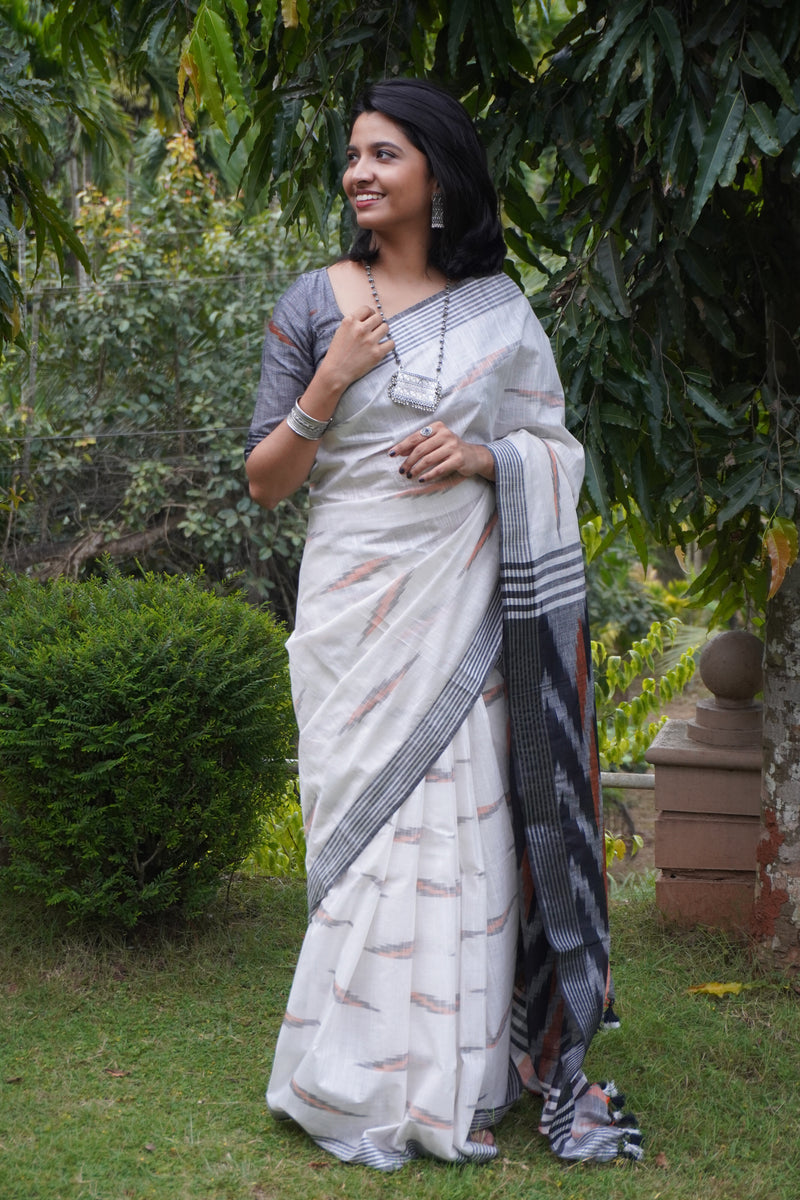
Single Ikkat vs. Double Ikkat
In Single Ikkat, either the warp or the weft threads are resist-dyed before weaving. In Double Ikkat — one of the most technically demanding textile processes in the world — both warp and weft threads are dyed and then aligned on the loom with microscopic precision so the patterns register perfectly. India is one of only three countries globally to produce Double Ikkat textiles; the other two are Japan and Indonesia.
"In Ikkat, the design is a prophecy woven into the thread — long before the fabric comes into existence."
Pochampally: India's Ikkat Capital
Pochampally in Telangana is the heartland of Double Ikkat weaving. The geometric patterns produced here — diamonds, chevrons, interlocking squares — are instantly recognisable and carry Geographical Indication (GI) certification. Our Neeraja Pochampally Double Ikkat saree, Silkmark certified, is one of the most extraordinary pieces in our collection: a document of cultural mastery draped in six yards of silk.
A masterwork of the Pochampally loom — pure silk, GI-certified, and woven using the centuries-old double Ikkat technique where both warp and weft are individually dyed before weaving. A collector's piece.
View This SareeStyling Ikkat with Intention
Ikkat's bold geometric patterns make a statement on their own. The styling philosophy here is restraint — let the saree speak. Keep accessories minimal and elegant: stud earrings, a single bangle in gold or silver, and understated footwear. For a contemporary twist, the Ikkat saree drapes beautifully over a solid-coloured boat-neck blouse. In office settings, the structured geometry of Ikkat reads as sophisticated and confident without trying too hard.
Comments
Be the first to comment.
Leave a comment